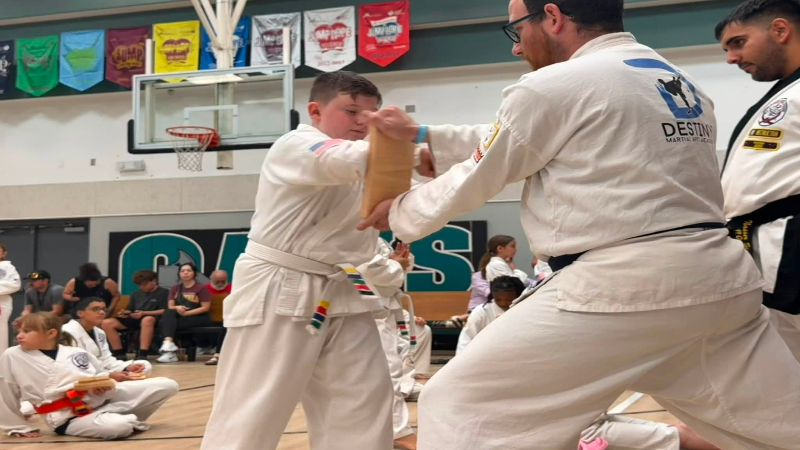
Karate students practice techniques on both sides of the body so that neither side is left behind. A right punch is followed by a left punch. A front kick with the right leg is repeated with the left. For children ages 6 and 7, that habit does more than keep drills balanced. It gives them steady practice at skills they are still building, like telling left from right, coordinating two sides of the body and controlling the hand or foot that doesn’t feel natural yet.
Parents watching a class may notice their child looks confident on one side and wobbly on the other. That’s expected. The weaker side is exactly where much of the learning happens.
What Does “Training Both Sides” Look Like in Class?
In most karate classes, techniques are practiced in pairs. A student punches with the right hand, then the left. They step forward into a stance with one foot leading, then switch. Blocks, kicks and turns are drilled to both sides, often for the same number of repetitions.
Forms, the set patterns of movement many traditional styles teach, often move in several directions and use both hands and both legs. Partner drills can be set up so each child takes turns leading with each side. Over time, students learn that “doing it on the other side” isn’t an extra step. It’s part of doing the technique at all.
This is very different from many childhood activities, where kids naturally favor one side. A child who always kicks a ball with the right foot or throws with the right hand gets little practice on the left. Karate builds the other side into the routine.
Why Is This Age a Good Time to Work on Both Sides?
Ages 6 and 7 sit in the middle of several developmental changes that both-sided practice touches.
Left and right are still being sorted out. Knowing which side is which takes longer than many adults remember. In one study of 406 children, kids used the words “right” and “left” correctly on their own bodies as early as age 7, then on people facing away, and finally on people facing them around ages 8 to 9. The same research found that even at age 11, half the children still didn’t apply the words properly to other people. A 6-year-old who steps with the wrong foot isn’t being careless. They’re working on a skill that is still developing.
Hand preference is getting stronger. Researchers have suggested that the direction of a child’s hand preference is set around age 3, while the strength of that preference increases between ages 3 and 7 and more gradually until about age 9. In other words, many first graders are leaning more on their dominant side every year. Regular practice with the non-dominant side gives that side more experience without trying to change which hand a child prefers.
Coordination is moving from simple to layered. Occupational therapists describe bilateral coordination as the ability to use both sides of the body together in a coordinated, sequenced way. Many karate techniques ask for exactly that: one hand punches while the other pulls back to the hip, or the arms block while the feet step. Doing that on both sides doubles the practice.
How Do Instructors Teach Left and Right to Young Students?
Because left and right are still shaky at this age, good instructors don’t rely on the words alone. A few common approaches:
- Mirroring. An instructor facing the class often moves the opposite hand so students can copy what they see. Fitness teachers do the same thing, calling out a left knee while lifting their own right to mirror the group.
- Landmarks instead of labels. Cues like “the hand closest to the wall” or “the foot near the window” give kids something concrete to anchor to.
- Markers. Some schools use a belt knot, a wristband or tape on the mat to show which side is first.
- Same side first, every time. Starting each drill on the same side builds a predictable pattern, so kids spend less energy guessing and more energy moving.
- Slow first, then switch. Doing a technique slowly on the weaker side before speeding up helps children notice what feels different.
These methods also explain why karate lessons for 6 year olds tend to look a little different from classes for older kids. Directions are shorter, demonstrations are frequent and the instructor checks sides often. By the time children reach karate lessons for 7 year olds, many can hold a longer sequence and switch sides with fewer reminders, though plenty still need a prompt now and then.
What Do Kids Gain From Using Their “Other” Side?
The benefits are practical rather than dramatic.
More balanced movement. Practicing kicks on both legs means a child spends time standing on each leg too. Balancing on the less familiar side is often the hardest part, and it improves with repetition. Each leg gets a turn as the kicking leg and as the standing leg, so neither one does all the work while the other only watches.
Better body awareness. Switching sides asks children to notice how their body is positioned and what each limb is doing. That awareness carries into other sports and playground games.
A useful kind of frustration. The weaker side is slower and clumsier at first. Working through that teaches kids that “hard” doesn’t mean “can’t.” When a child finally lands a clean left-side kick, the improvement is easy to see, which makes the effort feel worth it.
Regular, active movement. The CDC says children ages 6 to 17 need at least 60 minutes of physical activity every day, and it lists martial arts among its examples of aerobic activity. Drilling both sides naturally adds more repetitions to each class.
It’s worth keeping expectations realistic. Practicing both sides won’t turn a right-handed child into a left-handed one, and it isn’t a treatment for any condition. It simply gives children a wider range of movement to work with.
How Can Parents Support Both-Sided Practice at Home?
A few minutes of playful practice can help class lessons stick:
- Play “switch it.” Ask your child to show you a technique, then call “switch!” and have them do it on the other side.
- Use the less-used side in everyday tasks. Kicking a ball with the other foot, hopping on the other leg or carrying a light bag in the other hand adds easy practice.
- Mix up left-right games. Simple versions of Simon Says, like “touch your left ear with your right hand,” turn a tricky concept into a game.
- Praise effort on the weaker side. Notice when they try, not just when it looks good: “You kept going on your left side even when it was harder.”
- Ask what they learned. Having a child teach you a move, including which side goes first, helps them recall the sequence.
Keep it short and light. The goal is extra exposure, not extra pressure.
When Should Parents Ask for More Guidance?
Some unevenness between sides is normal at this age, and every child develops on their own timeline. Still, if a child has ongoing trouble using both hands together, avoids reaching across their body or struggles with coordination in many settings, it’s reasonable to mention it to their pediatrician. Occupational therapists often evaluate these skills, and a doctor can help decide whether that step makes sense.
It also helps to talk with the instructor. They see your child move every week and can share which side needs more attention and how to practice it.
What Should Families Look for When Comparing Classes?
Whether families are in Peoria or anywhere else, watching a class says more than reading a schedule. When comparing martial arts for 7 year olds, a few questions are worth asking:
- Are techniques regularly practiced on both sides, not just the strong one?
- How do instructors help kids who mix up left and right?
- Are directions short and demonstrated, not just explained?
- Do students get time to practice the weaker side slowly before speeding up?
- Is the class grouped by age, so the pace fits 6- and 7-year-olds?
Parents who are new to martial arts for 6 year olds may find it helpful to watch how the instructor handles that switch to the second side. It’s one of the clearest windows into how a class is taught.
A Habit That Pays Off Over Time
Training both sides can look repetitive from the sidelines. For a 6- or 7-year-old, though, each switch is a small coordination challenge, a quick check on left and right and a chance to get more comfortable with the side that doesn’t come naturally. Done week after week, it adds up to a child who moves with more balance and is more willing to keep at the hard parts.
About brief
Place this at the end of the article. The last brief led with the address and the Tiny Tigers class. This one leads with the owners and their WTSDA credentials, and uses a different Google Maps phrase.
About Destiny Martial Arts Academy
Led by fourth-degree masters Brooke and Lucas Aderhold, Destiny Martial Arts Academy teaches traditional Tang Soo Do, sometimes called Korean karate, to students from age 4 through adulthood, including a Little Dragons class for ages 6 and 7. Their instructors are certified through the World Tang Soo Do Association, and the school is a certified WTSDA studio. The academy is at 13644 N 75th Ave, Suite 103, in Peoria, AZ. Families can call (623) 213-8457 or see where they’re located on Google Maps.
Louis Shea
Louis Shea, an experienced wordsmith, channels his passion for knowledge into creating compelling articles and blogs across a broad spectrum of subjects. From the realms of technology and science to the nuances of lifestyle and culture, he navigates diverse topics with precision and enthusiasm, offering invaluable insights to his audience. With a background in Journalism and a wealth of professional experience, Louis approaches each piece with a steadfast commitment to accuracy and lucidity, ensuring his readers receive credible and comprehensive information. His writing style effortlessly blends professionalism with accessibility, adept at making intricate concepts accessible to readers from all walks of life. Whether he's dissecting the latest breakthroughs in AI or unraveling the mysteries of ancient civilizations, Louis possesses a unique ability to distill complex information into engaging content that both educates and entertains. Constantly attuned to emerging trends and advancements, Louis Shea remains a trusted authority in the digital sphere, enriching the online community with his insightful perspectives and captivating narratives.

