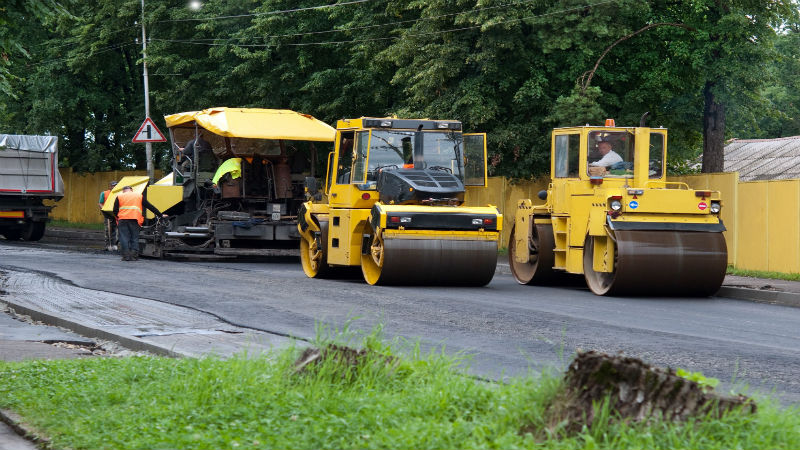
A business can often remain open during commercial parking lot paving by dividing the work into manageable phases, maintaining clearly identified access routes, and communicating temporary changes before construction begins. The right plan depends on the property layout, paving scope, traffic patterns, business hours, and how customers, employees, tenants, and delivery vehicles use the site.
For commercial properties in Phoenix, AZ, closing an entire parking lot may not always be practical. Retail centers still need customer access, offices need employee parking, restaurants receive deliveries, and multi-tenant properties may have different operating schedules throughout the day.
Keeping a property operational therefore requires more than scheduling a paving date. It requires a plan for how people and vehicles will move through the site while portions of the pavement are temporarily unavailable.
Can Commercial Parking Lot Paving Be Completed in Phases?
Yes, many commercial projects can be divided into separate work areas rather than addressing the entire parking lot at once.
Phasing allows one section to be under construction while another portion remains available. Once the first work zone reaches the appropriate point for reopening, activity can move to the next section.
The feasibility of that approach depends on the property itself.
A large shopping center with multiple entrances may offer more flexibility than a small property with only one driveway. Likewise, a business with separate customer and delivery areas may have more options than a site where every vehicle uses the same route.
Before establishing phases, the project team should consider:
- Number and location of entrances
- Customer parking needs
- Employee parking
- Tenant access
- Loading and delivery areas
- Drive-through lanes, when applicable
- Accessible routes and parking requirements
- Emergency and service access
- Connections between neighboring properties
- Areas needed for paving equipment and materials
A commercial paving contractor can then evaluate how the physical paving scope fits those operational needs.
Which Parts of the Parking Lot Should Be Paved First?
There is no universal order.
The first work area should be selected based on both pavement requirements and how the property functions. Starting in the largest open section may appear efficient, but that approach may not make sense if it removes the only practical route to a loading dock or blocks most customer parking.
Instead, project sequencing should look at circulation.
For example, a retail property might divide work so one primary entrance and a group of parking spaces remain available while another portion is being paved. An office property might shift employees to a different parking area while work occurs near the main lot.
A multi-tenant center may need a different strategy because each tenant can have distinct customer traffic and delivery patterns.
The goal is not simply to keep as many spaces open as possible. It is to keep the available portion of the property usable without routing normal traffic directly through active construction.
How Should Customer Access Be Planned During Paving?
Customer access should be simple enough that someone arriving at the property can understand where to go without already knowing the construction plan.
That usually means identifying:
- Which entrance remains open
- Which parking section is available
- Which drive aisles are temporarily closed
- How customers reach building entrances
- Where pedestrians should avoid active work
Temporary directional signs, cones, barricades, or other traffic-control measures may be used depending on the property and scope.
Communication outside the parking lot can help as well.
A business can notify customers through its website, email list, appointment confirmations, social media, storefront signage, or other normal communication channels. The message does not need to be complicated. Customers mainly need to know that the business remains open, where they should enter, and whether normal parking has temporarily changed.
Planning this before commercial parking lot paving starts is far easier than trying to redirect confused traffic after equipment is already working.
What Should Multi-Tenant Properties Consider?
Shopping centers, office complexes, medical plazas, and other multi-tenant properties add another layer of coordination.
One tenant may open early in the morning while another operates late into the evening. Restaurants may receive deliveries at different times from offices or retail stores. Some businesses may also depend more heavily on short-term customer parking near their entrance.
Property managers should collect this information before deciding how construction phases will work.
Useful questions include:
- Which tenants have the busiest customer periods?
- Are certain entrances more important to specific businesses?
- When do regular deliveries occur?
- Do any tenants require frequent service-vehicle access?
- Which parking areas are heavily used by employees?
- Are there shared loading zones?
- Are there scheduled events during the proposed construction period?
This operational information can then be considered alongside the technical paving requirements.
A good phasing plan does not guarantee that every tenant will have normal parking throughout construction. It does, however, make temporary changes more predictable and easier to communicate.
How Can Employee Parking Be Managed?
Employee parking can often provide some flexibility during paving because employees can be informed about temporary arrangements before arriving.
Depending on the property, employees may be assigned to an unaffected portion of the lot while customer-facing spaces remain available closer to the building.
Larger properties may rotate employee parking as paving phases change.
If off-site parking is being considered, the property owner or employer should confirm that the proposed location can legally and practically be used for that purpose rather than assuming a neighboring lot is available.
The important part is establishing the plan before employees arrive on the day work begins.
Without advance notice, vehicles may be left inside a work area, delay construction, or force last-minute changes to the planned sequence.
How Should Deliveries and Loading Areas Be Coordinated?
Delivery routes deserve separate attention because trucks may require more turning room and access than passenger vehicles.
A parking area that remains technically open to cars may not necessarily provide enough room for a delivery truck to reach a loading area.
Businesses should identify regular delivery schedules during pre-project planning.
Where practical, deliveries may be coordinated around individual work phases or scheduled for periods when the required route is available. If temporary access is planned, the route needs to account for the type of vehicles normally using it.
This is particularly important for restaurants, grocery-related businesses, warehouses, retail centers, and properties that receive frequent shipments.
The paving crew also needs to know about critical loading areas so the paving sequence does not unintentionally isolate them.
Can Paving Be Scheduled Around Business Hours?
Sometimes, but scheduling depends on the specific work being performed, property conditions, weather, available lighting, noise considerations, material requirements, and other project constraints.
Businesses should discuss operating hours during project planning rather than assuming that all paving can occur overnight or outside customer hours.
In some cases, adjusting the sequence may reduce interference with peak business activity even if the paving itself still occurs during normal daytime hours.
For example, work near a busy restaurant entrance might be planned differently from work near an office section whose heaviest vehicle movement occurs during morning and evening commuting periods.
The purpose of discussing hours is to understand when disruption has the greatest impact and determine whether the construction plan can reasonably account for it.
How Much Parking Needs to Remain Available?
There is no single percentage that applies to every commercial property.
Parking needs depend on property type, occupancy, time of day, tenant demand, local requirements, and the scope of construction.
Rather than selecting an arbitrary number, property managers should determine which parking spaces and circulation routes are essential during each phase.
Accessible parking and routes also require particular attention. Temporary construction arrangements should not casually block designated accessible areas or create unusable paths without considering applicable requirements.
Where regulatory or accessibility questions affect the construction plan, property owners should rely on the applicable plans, requirements, and qualified project professionals rather than generalized assumptions.
How Do Milling and Removal Affect Business Access?
Not every commercial asphalt paving project begins by placing new asphalt.
Existing pavement may first require milling, removal, localized repair, grading, or another preparation method depending on its condition and the planned work.
Those activities influence phasing because a work zone may remain unavailable through several stages.
For instance, an area might first be closed for pavement removal, followed by preparation and paving. It should not automatically be treated as available simply because one piece of equipment has finished working there.
Property managers should therefore ask how long each project phase is expected to remain an active construction area and what conditions must be met before traffic returns.
Exact reopening times should come from the contractor managing the work because they depend on the specific pavement operation, materials, site conditions, and project requirements.
Why Should Utility and Concrete Work Be Scheduled Before Final Paving?
Commercial parking lots often contain more than asphalt.
They may include:
- Concrete curbs
- Gutters
- Sidewalks
- Drainage features
- Manholes
- Valve boxes
- Utility structures
- Loading pads
- Other fixed site improvements
If planned utility excavation or concrete work will disturb the pavement, sequencing becomes important.
Completing final asphalt and then reopening the same area for underground work can result in unnecessary disruption and pavement restoration.
Known utility, drainage, concrete, or grading work should therefore be discussed before final paving.
This broader coordination is one reason commercial paving services should be planned in relation to the entire property rather than treated as an isolated surface project.
What Should Businesses Communicate Before Work Begins?
Advance communication is one of the simplest ways to reduce confusion.
Different audiences may need different information.
Customers
Customers generally need to know that the business remains open, which entrance to use, and where parking is available.
Employees
Employees may need instructions about temporary parking areas, entrance changes, or dates when their usual spaces are unavailable.
Tenants
Tenants should understand the phasing plan so they can inform their customers, staff, and vendors.
Delivery Drivers and Vendors
Regular vendors may need temporary routing instructions or adjusted delivery times.
Property Staff
On-site managers, security teams, maintenance personnel, and other staff should know which sections are closed so they do not unintentionally direct vehicles toward active work.
The construction schedule may still change because of site conditions or other project factors. Communication should therefore include a way to distribute updates when necessary.
What Can Businesses Do Before the Paving Contractor Arrives?
Several preparation steps can make the first day of construction smoother.
Confirm that vehicles, stored materials, carts, dumpsters, trailers, temporary displays, and other movable objects are not left inside the scheduled work area.
Verify that affected tenants know the planned closure.
Review delivery schedules.
Make sure anyone responsible for opening the property understands which entrances or parking areas will be available.
Property managers should also communicate any site information that could affect construction, such as known utility activity, access agreements, planned events, or other contractors working on the property.
For businesses planning Commercial parking lot paving in Phoenix, AZ, discussing these operational details with the paving contractor before mobilization can help establish a project sequence that reflects both the pavement work and the way the property is actually used.
What Should Happen When a Work Zone Reopens?
Reopening one section is an important part of phased construction because traffic often needs to shift before the next area can close.
However, a property manager should not assume that a section is ready for vehicles solely because visible paving activity has stopped.
The paving contractor should determine when the area can reopen based on the work completed and project conditions.
Once reopening is authorized, temporary traffic patterns may also need to change.
Signs or barricades directing customers to the first available parking area may need to move. Employees may need new parking instructions. Delivery routes may shift again.
Treat each transition between phases as a small operational change rather than expecting everyone on the property to automatically understand the new pattern.
What Should Be Discussed With a Commercial Paving Contractor?
Before work starts, a useful planning conversation should cover both construction and property operations.
Businesses and property managers can discuss:
- Which areas are included in the paving scope?
- Can the work reasonably be divided into phases?
- Which entrances need to remain usable?
- Where will customers park during each phase?
- How will employee parking change?
- Are there regular deliveries or loading requirements?
- Are concrete, utility, or drainage projects happening at the same time?
- Are other contractors using the parking lot?
- Which areas need to remain accessible for essential property operations?
- How will schedule changes be communicated?
These questions do not replace construction planning by the contractor. They give the contractor better information about how the property functions so operational requirements can be considered during planning.
Staying Open Requires Planning Beyond the Asphalt
A business does not necessarily have to choose between closing completely and postponing needed pavement work. On properties where site layout and project conditions allow it, phased construction can help preserve portions of customer, tenant, employee, and delivery access while other sections are under construction.
The key is to plan around how the property actually operates.
Before work begins, commercial property owners in Phoenix should identify critical entrances, parking demands, delivery routes, tenant schedules, accessible areas, utilities, and other construction activities. Those details can then be coordinated with the technical requirements of the paving project.
A thoughtful plan cannot eliminate every inconvenience associated with active construction, but it can make temporary changes easier for businesses, customers, employees, and contractors to understand and manage.
Louis Shea
Louis Shea, an experienced wordsmith, channels his passion for knowledge into creating compelling articles and blogs across a broad spectrum of subjects. From the realms of technology and science to the nuances of lifestyle and culture, he navigates diverse topics with precision and enthusiasm, offering invaluable insights to his audience. With a background in Journalism and a wealth of professional experience, Louis approaches each piece with a steadfast commitment to accuracy and lucidity, ensuring his readers receive credible and comprehensive information. His writing style effortlessly blends professionalism with accessibility, adept at making intricate concepts accessible to readers from all walks of life. Whether he's dissecting the latest breakthroughs in AI or unraveling the mysteries of ancient civilizations, Louis possesses a unique ability to distill complex information into engaging content that both educates and entertains. Constantly attuned to emerging trends and advancements, Louis Shea remains a trusted authority in the digital sphere, enriching the online community with his insightful perspectives and captivating narratives.
